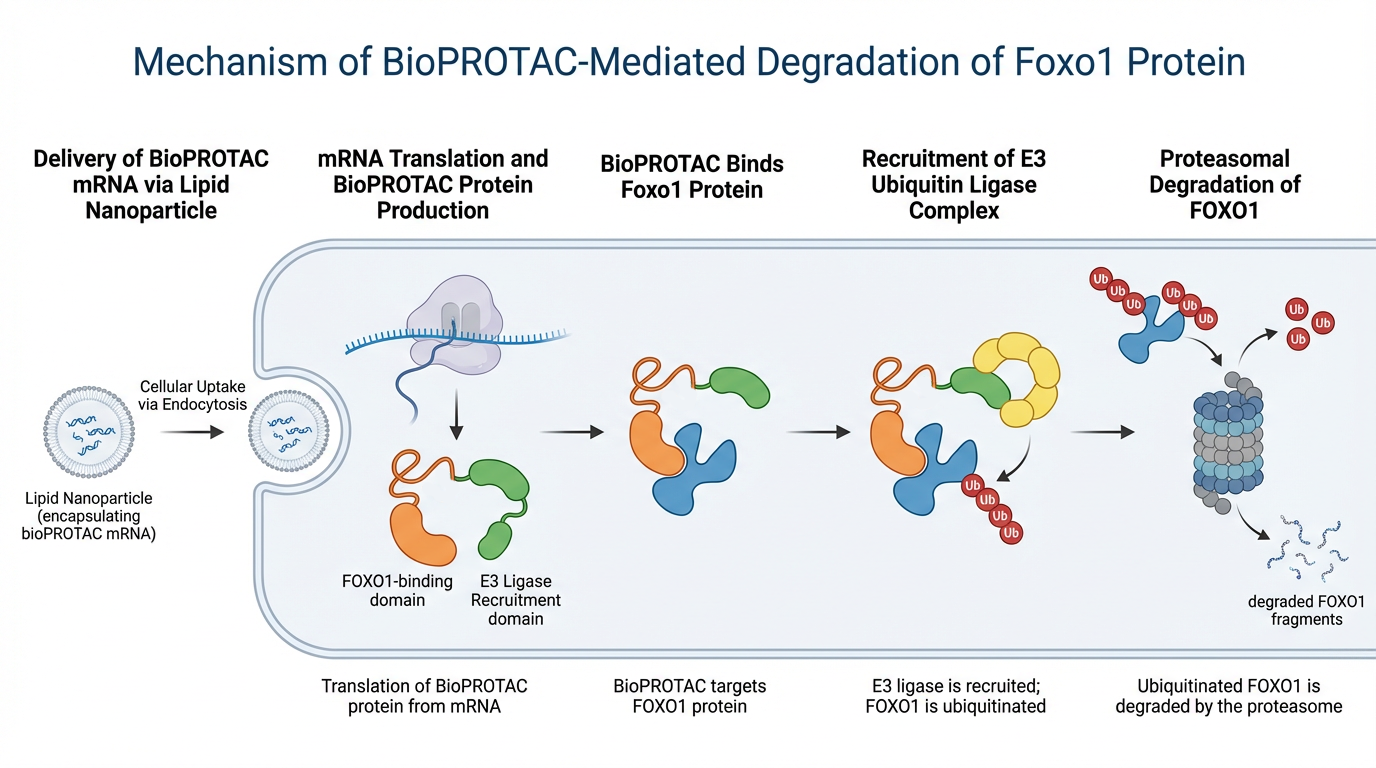

bioPROTAC and transcription factors
Intrinsically-disordered proteins are a hard paradigm for the typically-designed types of protein degrader medicines. Intrinsically-
PROTAC vs. bioPROTAC
Science appreciated that assembly of key proteins was necessary for certain biological functions. The recognition that assembly could be driven artificially came about when Craig Crews at Yale and Alessio Ciulli at Cambridge unraveled the biology of thalidomide and applied the concepts to other molecules, thus resulting in PROteolysis Targeting Chimeras
(PROTACs) for targeting degradation of proteins.
However, a PROTAC relies on a small molecular “hook” to attract protein intended for degradation. For proteins that are more free flowing without rigid shape, a small chemical hook with tight binding can be elusive. Nature solves this using other proteins.
Our goal is to use antibodies or nanobodies as the “hook” instead of relying on small-molecule binding, to achieve high specificity and strong interaction even with flexible, disordered targets.
Thus, as a result, bioPROTACs are designed can access a much broader range of disease-driving proteins—particularly those considered “undruggable”—making targeted protein degradation both more precise and more versatile.