
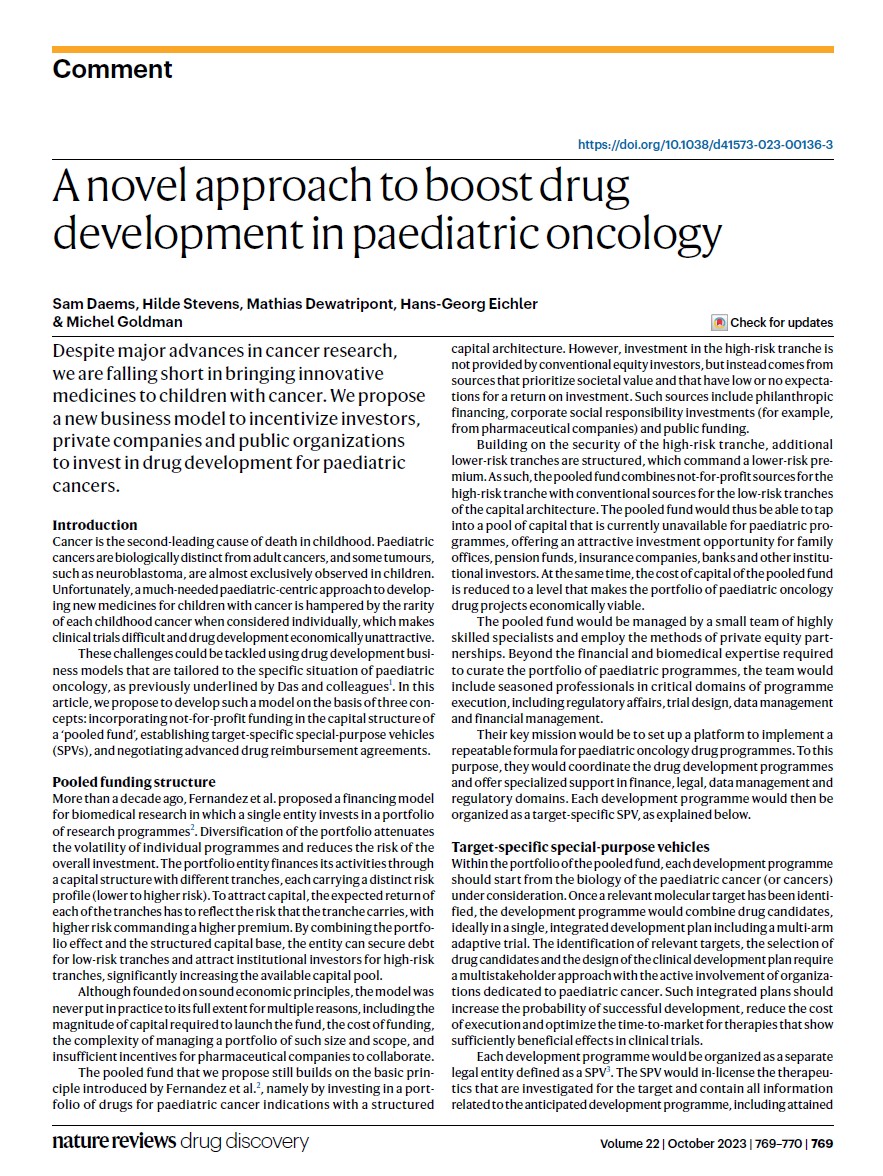
Economist and parent Sam Daems with colleagues published, “A novel approach to boost drug development in pediatric oncology” in Nature Reviews. Lucy and Team’s summary and perspective are below.
Summary
This article proposes a new business model to incentivize investors, private companies and public organizations to invest in drug development for pediatric cancers. Currently, it is very difficult to develop new medicines to treat these cancers, as they are biologically distinct from adult cancers and rarer, and therefore, unappealing to invest in. The proposed solution is to use drug development business models tailored to fit pediatric oncology. The proposed model would be developed on the basis of three concepts:
(A) pooled funding in a structured capital model,
(B) target-specific special-purpose vehicles (SPVs), and
(C) advanced drug reimbursement agreements
The pooled fund invests in a portfolio of pediatric cancer drugs using a structured capital model. It combines not-for-profit funding for high-risk tranches with conventional funding for lower-risk ones, allowing access to capital normally unavailable for pediatric programs, and making the investment opportunity appear more attractive and economically viable. Managed by specialists using private equity partnership methods, the goal is to create a platform that can establish this formula for use by pediatric oncology programs. Each program would be organized as a target-specific SPV, a separate legal entity that in-licenses therapeutics (containing crucial information), manages finances, and handles contractual agreements with third parties. Eventually, the SPV would become a platform for monetization, where proceeds flow into the pooled fund, then serve its cost of capital and/or (re)invest in new development programs through other SPVs. An advanced reimbursement agreement can reduce the risk of future pricing and reimbursement by health payers. The latter would also ensure that patients are directed to the most effective treatments and allow SPVs to generate income while proving a treatment’s value. However, logistically, these agreements are complex and can discourage payers.
Our Perspective
Pooled funding in a structured capital model distributes risk of different kinds to stakeholders (teaming return on investment in lives saved with nonprofit/foundation level investors, and return in dollars to investors for the more expensive phases of drug development. A win-win!
If roughly a drug should gross $5B in sales over five years to be profitable, $450,000-550,000 annually might be the cost per patient of receiving the bespoke pediatric cancer medicine. At this price tag, the drug should be very effective … but having insurance and government payors agree to reimbursement for such an effective drug will de-risk investor buy-in. Furthermore, there is no universal template for reimbursement agreements for SPVs. Because SPVs are tailored specifically for specific investments, it is important that reimbursement agreements are customized to fit the structure and purpose of each transaction. However, there are a few widely accepted templates for different kinds of transactions that can be accessed online.
Overall, We applaud the proposal by Daems and colleagues – their multiprong approach has the potential to boost advances in pediatric cancer drug development. The greater question is where (on which continent) this project could be piloted first?